
‘Economy still growing’
Federal Reserve Bank official chamber keynote speaker
Trending
MARSHALL -- When you look at the current state of the U.S. economy, there are some things that stand out, Joe Mahon said. While the economy is still seeing some growth, people are feeling the pressures of rising costs.
"Everything we can say about the labor market right now, about employment, is it’s going pretty well. It’s not going gangbusters, but we’re not in a recession," said Mahon, the regional outreach director at the Federal Reserve Bank of Minneapolis.
The country's gross domestic product grew at an annualized rate of 3.4% in the third quarter of this year.
"We’re not seeing massive job losses. The economy is still growing. And on the other hand, I don’t need to tell you all that inflation is too high. The cost of living is going up too much," Mahon said.
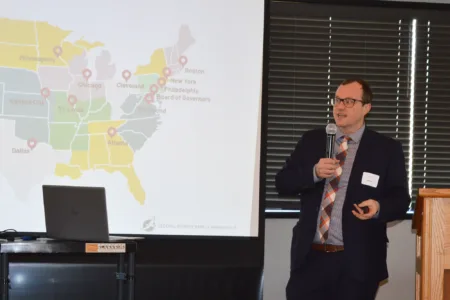
Mahon was the keynote speaker at the Marshall Area Chamber of Commerce's annual meeting on Wednesday. Mahon spoke to area residents about trends in the U.S. economy and agriculture, and gave some background about the Federal Reserve.
"The Federal Reserve is the central bank of the United States," Mahon said. "We're overseen by the government, and we're responsible to Congress."
The Fed was originally created to be a lender of last resort in times of financial crisis, he said.
Another key role of the Federal Reserve is monetary policy, like raising or lowering interest rates.
"One of the important features about the Fed is that we're a nonpartisan institution. We stay out of politics, and that's important so we can do a good job with the things we need to focus on," he said.
Mahon said that according to recent data, the U.S. economy is still growing.
"It was fairly broad-based growth," which included consumer spending and business investment, Mahon said. That business investment included equipment and other inputs for AI and data centers, he said. The build-out for AI was leading to economic activity, but also causing some of the inflation we're seeing right now, he said.
In the labor market, Mahon said, "We are starting to see maybe some negative impact on certain sectors in employment."
Mahon said over the past year, Minnesota has had a higher rate of unemployment than the national rate. It's an unusual situation, he said. Minnesota has usually had lower unemployment, "largely because we have a more educated workforce here," he said.
Mahon didn't know the cause for the change in Minnesota unemployment, but he said some factors that could have had an effect on employment in the state included a change in the trend of having a more educated workforce, and the effects of stepped-up immigration enforcement in early 2026.
There have also been declines in information and financial services employment, which are "relatively overrepresented sectors" in Minnesota, Mahon said.
Mahon said "the quick story" about the agriculture economy has been that farmers have seen a rough few years, particularly for crop farmers. A quarterly survey released by the Federal Reserve Bank of Minneapolis last week said farm incomes were still down in the third quarter of this year.
However, he said, there were also positive expectations for farm income in Quarter 4.
"I think that's due to some of this rally in crop prices that we're seeing right now," he said.